Concord, CA · Garage Door Service
Panel Replacement for Vine Hill's 1973-Era Garage Doors
Vine Hill homes went up around 1973, and that era's panel sizing and hardware don't match what's on the shelf today. Here's what panel replacement actually takes.
- Repairs & new doors
- Springs & openers
- Serving 6 nearby communities
What You Are Seeing
Vine Hill's housing stock centers on 1973, which puts it right in the stretch of construction across this part of the service area when steel sectional doors were taking over from the last single-panel wood doors. If your house still has its original door, you're likely looking at either an early steel sectional with narrower panel grooves than current lines, or a wood door that's been repainted a dozen times and is starting to delaminate at the seams. Either way, the panel profile on a door from that build year rarely lines up with what a big-box store carries now.
Damage shows up differently depending on which you have. On steel, a cracked or caved panel usually comes from a backed-into car or a wind-driven branch, and it stays isolated to that section unless the track bent with it. On wood, panels swell and split along the grain over the decades, and by the time one panel fails, the others close to it usually aren't far behind. We look at the whole door before quoting one panel, because on a door this old, matching one section perfectly is sometimes less realistic than you'd want.
Stocked Parts
The service area runs mostly 1960s-70s stock across its named neighborhoods, so our trucks carry panel sections and end caps sized for that era's common door widths, not just whatever ships with a new installation kit. That covers a fair number of the doors we see in Vine Hill. What it doesn't cover is an exact color or wood-grain match on a door that's been through decades of sun and repainting - pigments fade differently panel to panel, and a factory-fresh replacement section can sit noticeably lighter or darker next to the original ones.
We'll be straight about that before we start: if your panel is a steel profile still in production, we can usually source and swap it in one visit. If it's a discontinued groove pattern or a wood style nobody mills anymore, the honest options are repainting the whole door to blend a new panel in, or replacing the full door instead of chasing a part that may not exist. We'd rather tell you that up front than have you find out after we've ordered the wrong thing.
Time on the Job
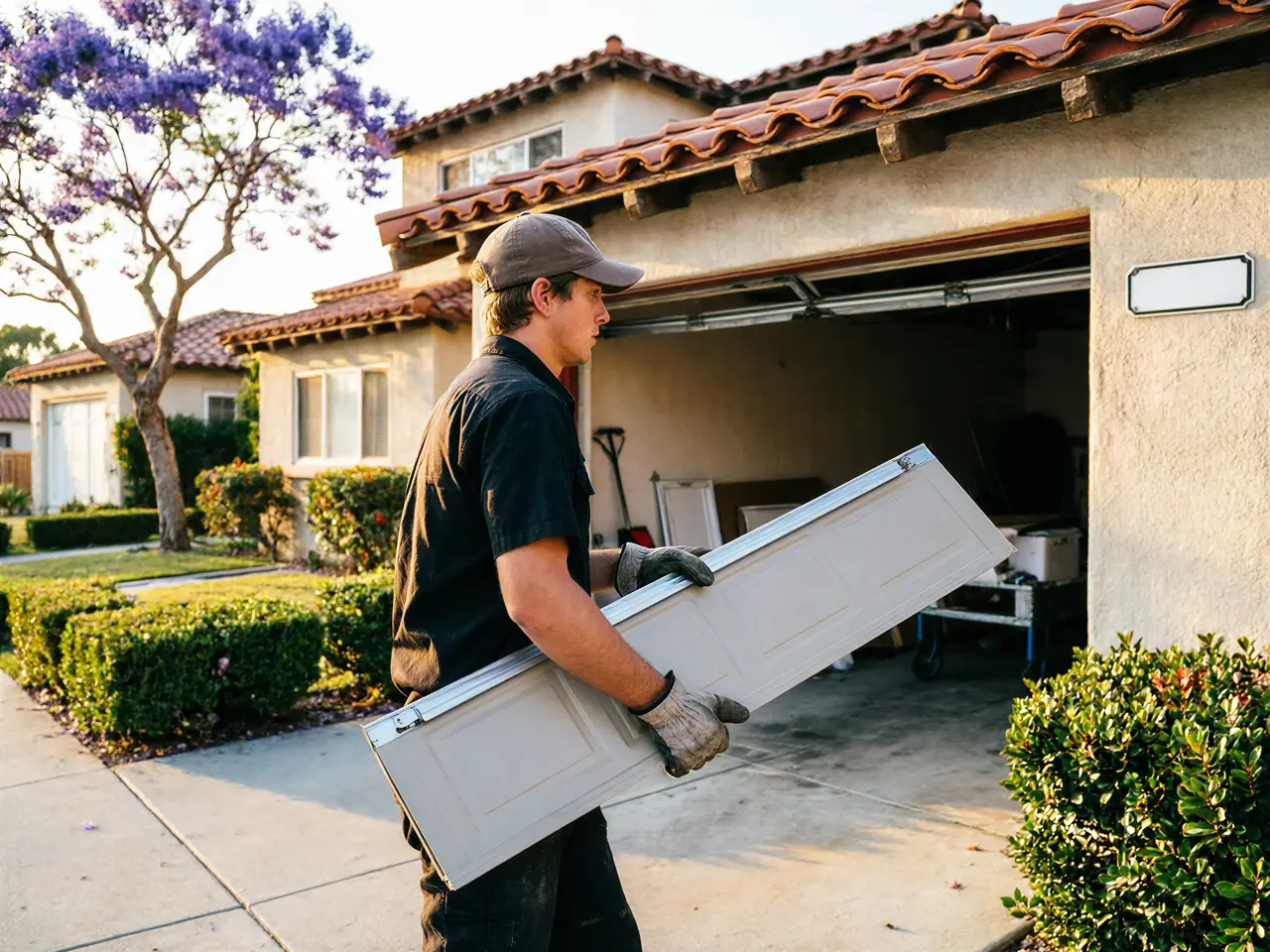
Concord is about 5 miles out, which keeps the trip short enough that travel isn't the thing that eats the schedule - the panel itself usually is. A steel panel swap on hardware that's still standard takes a straightforward afternoon: pull the damaged section, transfer the hinges and rollers, reseat the track alignment, and test the balance since a new panel changes the door's weight distribution slightly even when it's the same size.
Wood panel work runs longer, because splits along old grain often mean resetting hinges into wood that's gone soft around the original screw holes, not just bolting a new piece in. The mild temperate climate here means we're not fighting frozen hardware or swollen wood from seasonal extremes the way a crew somewhere colder would, so the extra time on wood doors is about the material's age, not the weather.
What the Repair Takes
Start to finish: we disconnect the opener arm before touching the panel, so the door doesn't try to cycle mid-repair. The damaged section comes out, hinges and rollers transfer to the replacement, and we check that the track hasn't bowed where the impact happened - a bent track is a separate fix and worth catching now rather than after the new panel's in.
Once the panel's seated, we rebalance the spring tension. A different panel, even one the same size, shifts the door's weight slightly, and skipping the rebalance is how openers start straining within a few months. On a 1973-era door, we also check whether the torsion hardware on the header is original - hardware that old sometimes needs replacing alongside the panel rather than after it fails on its own.
We don't try to match a 50-year-old wood grain by eye and call it invisible. If blending matters to you, repainting the full door is the realistic path, and we'll say so rather than let you expect a seam you won't get.
Frequently asked questions
Can you match the panel color on my older door exactly?
Not reliably. A door built around 1973 has had decades of fading and repainting, and a new panel section comes out of the factory at the original pigment. If a close match matters to you, repainting the full door after the panel swap is the more honest path than hoping a single new section blends in.
Is my door even worth repairing or should I replace the whole thing?
Depends on what's failing. One cracked steel panel on otherwise sound hardware is usually a straightforward swap. Multiple split wood panels, or a discontinued groove profile we can't source, often tips the math toward full replacement instead of chasing parts for a door this old.
Do you carry parts for older doors on the truck?
We stock panel sections and hardware sized for the 1960s-70s era stock common across this part of the service area, which covers a lot of what we see in Vine Hill. Discontinued wood styles or older groove patterns sometimes need sourcing before we can start.
More garage door services in Vine Hill
Book garage door service in Concord
Call now or request a quote - tell us what the door is doing and where you are.