Concord, CA · Garage Door Service
Emergency Garage Door Repair for Clayton's 1980s Doors
Clayton's garage doors mostly date to the 1980s building boom - steel sectional doors on torsion springs, not the older stock common closer to Concord. We come out from Concord, 4 miles away.
- Repairs & new doors
- Springs & openers
- Serving 6 nearby communities
The Complications
Most houses in Clayton went up around 1984, well after the older neighborhoods closer to Concord that still carry doors from the 1950s and 60s. That matters because a door built in 1984 is almost always a steel sectional door on a torsion spring system, not the older wood or single-panel doors with extension springs that you still find on the earlier stock elsewhere in the service area. Steel sectional doors from that era are wider, built for two-car openings, and they carry heavier torsion springs sized for that extra width. When one of those springs goes, it usually goes loud, and the door won't move at all until it's replaced. The complication with doors this age isn't rot or warped wood panels, it's wear on the original hardware: rollers that were never nylon, worn end bearings, and torsion springs that have outlived their rated cycle count. Because Clayton's stock is fairly uniform in age, we see the same failure pattern across the area - it's not scattered like it is in neighborhoods with a wider mix of build years. A snapped cable or a seized torsion spring on a mid-80s double door is the call we get most, and the fix is usually straightforward once we're on site, but getting the right spring size matters more here than guessing.
Time on the Job
We work out of Concord, about 4 miles from Clayton, so there's no separate crew or branch sitting in town - we drive the job in. On a typical mid-80s steel double door, a torsion spring swap or a cable replacement is a bounded job once we've got the right parts on the truck, but we won't promise a clock time we can't back up. What we can tell you is that the work itself - pulling a broken spring, re-cabling a track, resetting an opener that's lost its position - doesn't take all day on a door this age, because the hardware is standard sectional-door sizing, not an odd custom fit you'd find on an older or architect-built home. The drive is short; the labor is the variable.
Getting It Booked In
Call it in, tell us what the door is doing - won't open, opener runs but the door doesn't move, spring snapped with a bang - and we'll ask the door's age and whether it's single or double car. For Clayton that's almost always going to land us near a 1980s steel sectional door on torsion springs, which helps us load the right spring size and cable length before we leave Concord instead of diagnosing cold. If you can see a visible gap in the spring above the door, say so; it saves a trip back for the wrong part. We'd rather ask three questions on the phone than show up guessing.
Can You Do This Yourself
A torsion spring under tension is not a DIY repair - it can put you in the hospital if it releases while you're working on it, no matter how old or new the door is. What you can safely do yourself: check whether the opener's safety sensors are aligned, listen for a snapped spring (a loud bang, then the door feels twice as heavy), and visually check the cables for fraying before you touch anything. If the door is a 1980s steel sectional and one side has visibly dropped while the other looks normal, that's usually a cable or one of the two torsion springs, and it's a call, not a weekend project. The honest limit here: we don't talk anyone through a spring swap over the phone. It's not a trust issue, it's a physics one.
What You Are Seeing
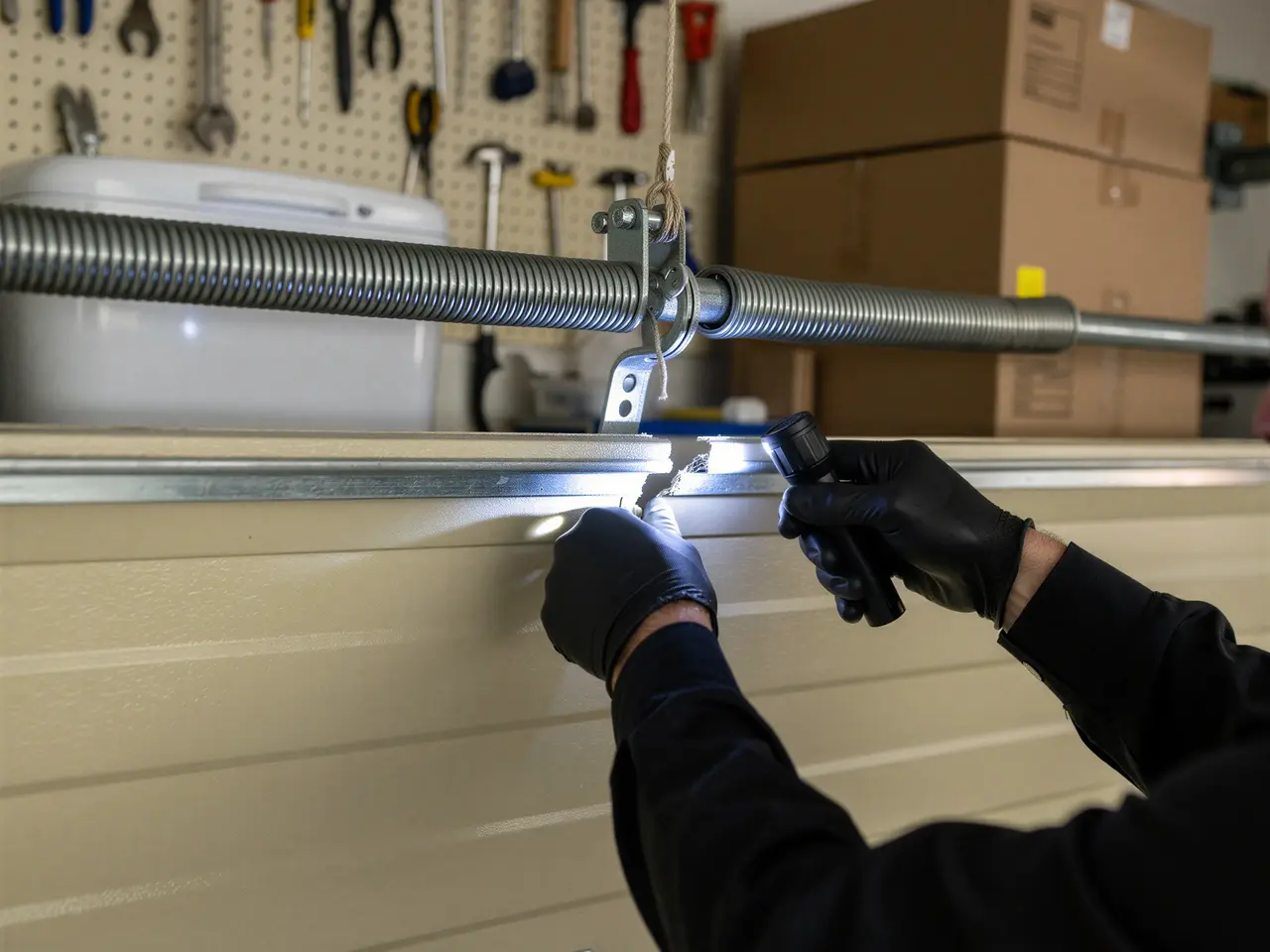
If your door is slamming down the last foot of travel, that's often a worn torsion spring losing tension unevenly rather than a dead opener. If it opens partway and reverses, check the sensors first, but on a door built around 1984 it can also be a track that's walked out of alignment over the decades. A door that won't budge at all, with a visible gap or kink in the spring coil above the opening, is a broken torsion spring - common on double steel doors of this age once the spring hits the end of its cycle life. None of this is Clayton-specific weather damage; the climate here is mild, so what you're dealing with is mechanical fatigue on 1980s-era hardware, not rust or warped panels from extreme swings.
Frequently asked questions
Why does my door's age matter for the repair?
Because it tells us what hardware is inside before we open the panel. Clayton's housing mostly dates to the mid-1980s, which almost always means a steel sectional double door on torsion springs - standard sizing we can load on the truck in Concord before we drive the 4 miles out, instead of guessing at parts on site.
Do you have a crew based in Clayton?
No. We work out of Concord, about 4 miles away, and drive out for every call. There's no separate branch in Clayton - just a short trip from where the trucks are.
Is a broken spring on a 1980s door different from an older house's spring?
Usually yes. Doors built around 1984 are almost always steel sectional doors on torsion springs sized for a full double-car opening, while older stock elsewhere in the area can still have single-panel doors on extension springs. The repair approach and spring size differ.
Can I replace the torsion spring myself?
No. A torsion spring holds enough stored tension to cause serious injury if it releases while you're working on it. This holds regardless of the door's age. Checking sensor alignment and listening for a snapped spring is fine to do yourself - swapping the spring isn't.
Book garage door service in Concord
Call now or request a quote - tell us what the door is doing and where you are.